
Find Folsom Residents by the Right Record
Folsom has no single residents roll. The useful record depends on the question and on the key that starts the search. An address can lead to a parcel and then to the secured assessment roll. A name can lead to a Sacramento Superior Court party index, a business filing, a license record, or a historical directory. A date or family relationship points toward vital records, probate, newspapers, and cemetery material.
These sources do not carry the same meaning. An assessment roll names an assessed owner and tax-mail destination, not every person at a property. A deed indexes a party to a described interest, not physical presence. A voter result reports registration status through an identity check, not an open street list. Directory volumes are snapshots that can omit minors, non-subscribers, rural addresses, and people who used another spelling.
- Choose the strongest starting key: normalized address, APN, full name with variants, event date, or former settlement name.
- Use the Assessor Parcel Viewer for a parcel and APN, then request the secured owner and mailing fields through the county access channel when needed.
- Search the Recorder party index for a deed, deed of trust, reconveyance, lien, release, or map, and preserve the document number and legal description.
- Use the California voter status tool only for personal verification, or make a qualified voter-file request with a lawful declared purpose.
- Pair current records with the Sacramento Room, court, newspaper, census, vital, and archive sources that fit the person or address.
Note: A result is a record of an event, filing, or status; it is not a promise that a named person lives at an address today.
Folsom Resident Records Have Separate Custodians
Folsom is an incorporated city in Sacramento County, so the strongest resident trail crosses municipal, county, state, and court systems. City Hall at 50 Natoma Street handles municipal agendas, contracts, ordinances, permits, and public-records requests. The county handles the parcel roll, recorded instruments, elections, tax records, and local vital certificates. State systems add voter verification, professional affiliations, corporations, custody, and statewide certificate products.
The Folsom City Clerk public-records channel asks for an existing record, a date range, a department, and useful name, address, or project identifiers. It does not require the city to create a new residents list or perform a chain-of-title analysis. For recorded documents, begin with the Sacramento County Clerk/Recorder Online Index; the Assessor and Recorder answer different questions.
Sacramento County Clerk/Recorder
Recorded deeds, liens, maps, marriages, and fictitious business names.
Online index, counter terminals, copies, and certification paths.
Sacramento County Assessor
APNs, situs, secured roll fields, values, land-use codes, and parcel maps.
Viewer online; owner and mailing fields through the public roll.
Sacramento County Elections
Registration administration, precinct and district data, and qualified voter files.
Personal status lookup or purpose-limited application.
City records, county records, court files, and historical collections should be cited by their custodian and record type. That habit prevents a business filing from being treated as a household record or a parcel value from being mistaken for a current market fact.
Start a Folsom Residents Directory Search with an Address
An address is often the cleanest entry point because the county map can return an APN even when the person name is unknown. Normalize the street suffix, remove unit punctuation if the search fails, and try the map when an exact string does not resolve. The APN is the bridge from a situs location to assessment facts, Recorder references, permits, and later historical work.
The Sacramento County Assessor Parcel Viewer accepts an address, APN, or map location. Its map controls let a researcher pan along a street, click adjoining parcels, and inspect the jurisdiction, land-use context, and parcel link. Owner names are deliberately absent online, so a parcel result is a starting key rather than a resident directory.
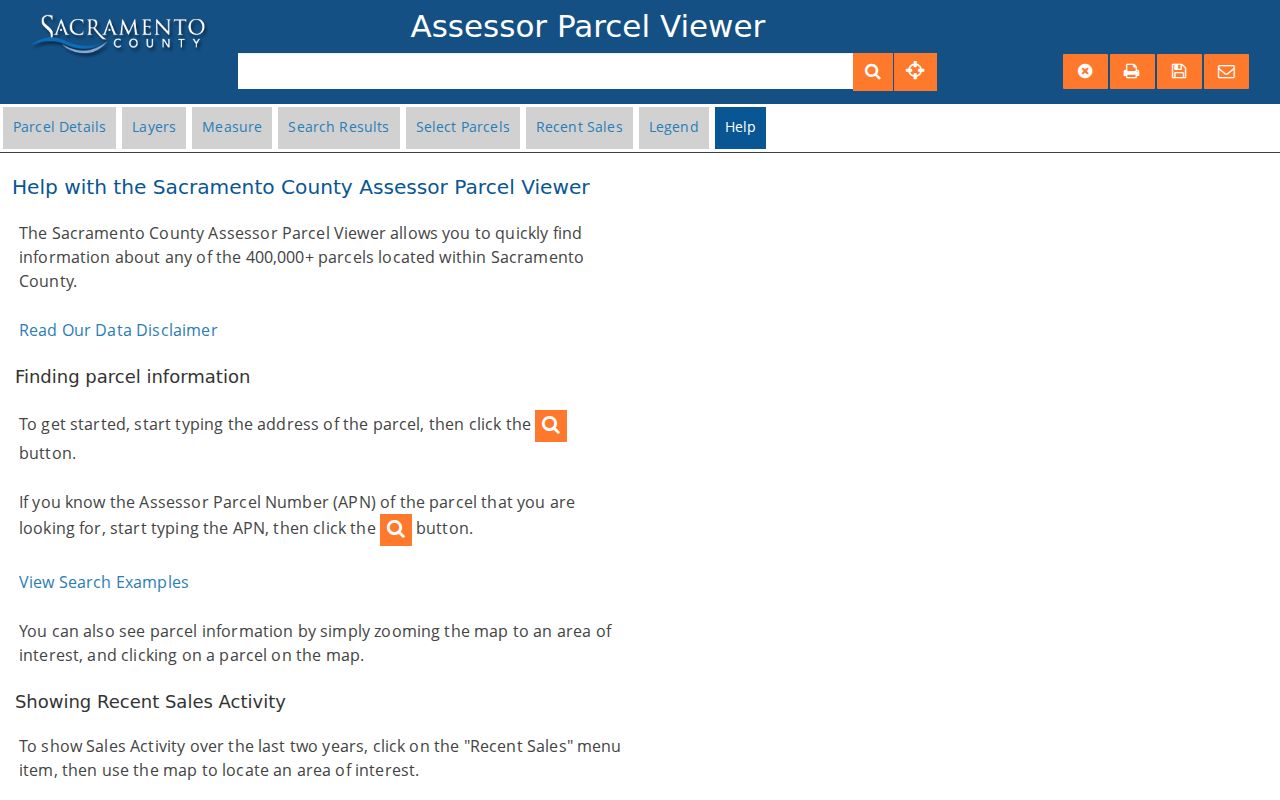
The parcel viewer image reflects the address and map side of a Folsom residents directory search. It helps establish the APN and the government jurisdiction before an owner or occupant conclusion is attempted.
| Assessor/GIS Field | Input or control | What it does | Limit |
|---|---|---|---|
| Address | Autocomplete or text | Finds a situs parcel after street-form cleanup. | Unit and suffix formatting can affect a match. |
| APN | County parcel number | Retrieves a known parcel and related map facts. | Punctuation tolerance varies. |
| Map click | Spatial selection | Finds parcels when an address string fails. | Assessment graphics are not a legal survey. |
| Zoom, pan, layer, legend | Map controls | Exposes adjacent parcels and available jurisdiction layers. | Layers can change, and no guaranteed radius export exists. |
| Identify | Click tool | Opens selected parcel facts and references. | Owner names stay out of the public web view. |
- Parcel
- A county assessment unit identified by an APN. It is a record key, not a complete household.
- Roll
- An assessment record for property and valuation fields. The secured roll can carry owner and mailing information offline.
- Situs address
- The physical location assigned to the parcel. It differs from a tax-mailing address.
- Criss-cross directory
- A reverse directory arranged by street and house number, useful for historical occupants and telephone clues.
Why Folsom Parcel Results Hide Owners
Sacramento County states that owner names are removed from the online viewer because of privacy concerns, while the secured public roll includes the owner, property address, and mailing address. A researcher can use the lobby computers at 3636 American River Drive, Suite 200, Sacramento, Monday through Friday from 8 a.m. to 5 p.m., or submit a focused electronic request through the county’s records process.
The Assessor’s public-record access explanation identifies useful fields such as APN, secured owner, situs, mailing address, assessed land and improvement values, exemption value, tax-rate area, zoning and land-use codes, Recorder book/page, parcel maps, and limited building characteristics. Ask for only the columns and APNs needed. A narrow request is easier to interpret than a demand for every record connected to a name.
Use the two-level trail. The web map supplies location and APN context. The counter or county request supplies public roll fields that the online map intentionally does not display.
Mailing and situs addresses should stay separate in notes. A mailing address can be another residence, a post office box, a trust, an estate, or an agent. A property-tax exemption may suggest owner occupancy, but neither an exemption nor an assessed owner proves that every household member occupies the parcel.
Note: Values update on the county’s annual cycle, with materials describing early July and mid-September refreshes; later corrections may not appear after September 15.
Current Folsom Residents Directory Sources
Current-looking records are really different snapshots. The useful comparison is what each source names, who keeps it, and whether access is open, authenticated, onsite, or purpose-limited. A business filing can show a registered agent or principal address. A directory or yearbook can place a person in a setting during a past period. None is a complete household roster.
| Source | What it can identify | Keeper | Access path |
|---|---|---|---|
| Parcel Viewer and secured roll | APN, situs, assessed owner, mailing destination | County Assessor | Viewer, counter, or focused request |
| Recorder index | Deed parties, liens, releases, maps, legal-description clues | County Clerk/Recorder | Online index, counter, copy desk |
| Public Case Access | Party name, case type, filing date, docket and public disposition | Sacramento Superior Court | Modern and historical portals; courthouse limits differ |
| My Voter Status | Personal registration status and election logistics | California Secretary of State | Authenticated self-lookup |
| Business and license searches | Entity, agent, filing address, credential status | California state agencies | Official name or number search |
| Directories, yearbooks, newspapers | Past occupants, school ties, notices, businesses, and address clues | Library and archives | Onsite collections or licensed databases |
| Commercial compilations | Mixed public and purchased data associations | Private publisher | Nonofficial; verify every lead with the custodian |
The table explains why a name search should not stop at one result. If the goal is one person, preserve middle initials, suffixes, former names, and spelling variants, then compare two anchors such as an APN plus deed party or an entity number plus filing address. If the goal is a street, use an address chain rather than treating a citywide name result as proof.
Official versus compiled. County, court, voter, library, and state records have named custodians and defined limits. Commercial compilations can be stale or misattributed and are not official proof.
Neighborhood associations, civic pages, school material, and public organization newsletters may supply voluntary contacts or community history. Research did not find a city umbrella page publishing resident member directories. Association board or management contacts are not membership rosters.
Folsom Resident Lookup Spans Two Court Eras
Folsom cases are filed in Sacramento Superior Court, where Public Case Access separates Civil, Probate, Family, Criminal, and Traffic material. The modern portal accepts division-specific name, case-number, and filing-date searches. The historical portal covers Civil cases filed from 1936 through 1995 and Probate cases from 1948 through 2007. Those ranges are a practical numbers check: a zero result in one interface is not a countywide negative.
For a court-based Folsom resident lookup, save the caption, case number, division, filing date, party role, status, register-of-actions entries, hearing information, and public document titles. Remote access is narrower for criminal, family, civil-harassment, sealed, juvenile, adoption, and other protected material. Courthouse electronic access can be broader under California Rule of Court 2.503.
The Sacramento Public Case Access search shows the portal used for current civil and probate work as well as the other public divisions. Its search screen is a finding aid, not a certified copy and not proof that every allegation in a filing is true.
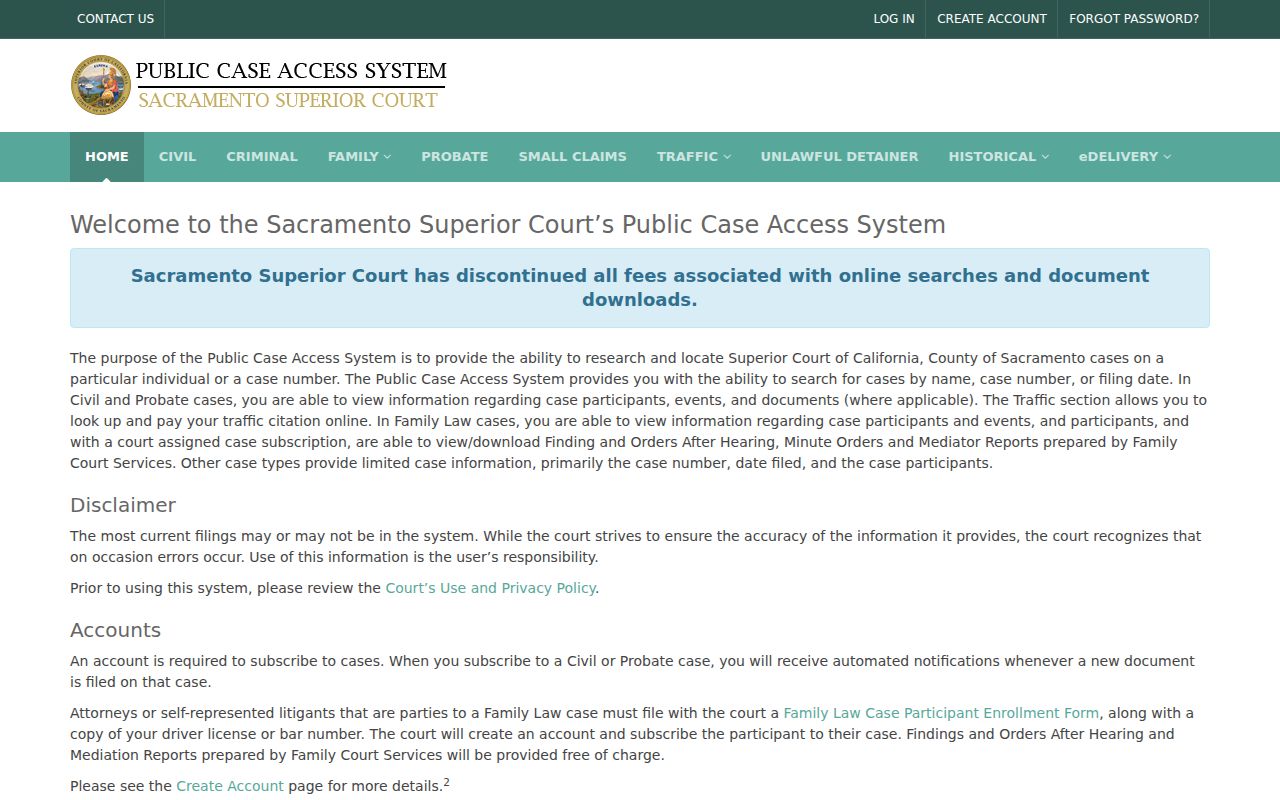
The court image connects a Folsom residents directory workflow to a party and case index. Older Civil and Probate work belongs in the historical route, while pre-1989 criminal indexes remain on public microfiche and later criminal searches use the clerk’s records process.
- Docket
- The running case record of filings, hearings, orders, and other register entries.
- Disposition
- The recorded procedural outcome shown when the public case record includes it.
- Index versus image
- An index points to a case or instrument; an image is a copy of a document and may still have access limits.
Federal matters use a separate Eastern District of California and PACER path. Narrow the court and filing date, then verify the caption and case number so a namesake is not mistaken for the intended person. During the court portal migration, online search and document-download fees were discontinued; confirm live behavior before relying on a current screen.
California Vital Records for a Folsom Resident
Birth, death, marriage, and divorce records answer event and relationship questions, not a general current-residence question. Sacramento County handles local birth, death, public-marriage, confidential-marriage, and related certificate requests. The California Department of Public Health provides statewide certified-copy products and applications. A divorce decree or case file comes from the Superior Court, while the state certificate-of-record product covers only divorces from 1962 through June 1984.
California uses authorized and informational copy classes rather than a simple rule that all records open after a fixed number of years. An informational copy is public but marked not valid to establish identity. An authorized certified copy requires a qualifying requester and sworn statement under Health and Safety Code sections 103526 and 103526.5. Confidential marriages are restricted under Family Code section 509.
| Record | Custodian | Useful question | Access boundary |
|---|---|---|---|
| Birth or death certificate | County Clerk/Recorder or CDPH-VR | Did the event occur, and what parent or relationship fields were registered? | Informational and authorized copy rules differ. |
| Public marriage | County for local event; CDPH statewide | What names and event details were recorded? | Eligibility depends on copy class and request. |
| Confidential marriage | County of issuance | Can an eligible party obtain the record? | Parties or court order under Family Code section 509. |
| Divorce decree or file | Sacramento Superior Court | What order or case event is in the court file? | Family and sealed-record limits apply. |
| Certificate of record of divorce | CDPH | Is a statewide certificate available for the covered period? | 1962 through June 1984 only; it is not the decree. |
The California vital-record application information lists fields such as record type, name, event date and place, parent or spouse names, requester identity, relationship, copy class, sworn statement, notary step when required, number of copies, and payment. A search fee can remain due even when no record is found, so use county, state, church, cemetery, newspaper, census, probate, and court substitutes for older or uncertain events.
Folsom Voter Status Is Not a Street Roll
California’s My Voter Status service is an authenticated self-lookup. It asks for identifying inputs and can return a voter’s registration or status, party preference, districts, polling information, vote-by-mail status, and participation-related information. A no-match means the supplied identity fields did not match; it does not prove nonresidence, and a registration record does not prove continuous physical occupancy.
The voter-file route is different. Elections Code section 2194 permits qualified election, scholarly, journalistic, political, or governmental uses. Government Code section 7924.000 protects home street address, phone, email, registration identifiers, prior registration, driver or ID data, Social Security digits, and signature except where a statute allows access. A requester must state purpose, geography, fields, recipient, and security controls. The voter file is not a lawful open block browser.
The California My Voter Status lookup illustrates the personal verification path for a Folsom resident. County Elections and the Secretary of State handle qualified data applications, while historical poll books, registration material, and precinct returns require a series and year request through the relevant elections or archive custodian.
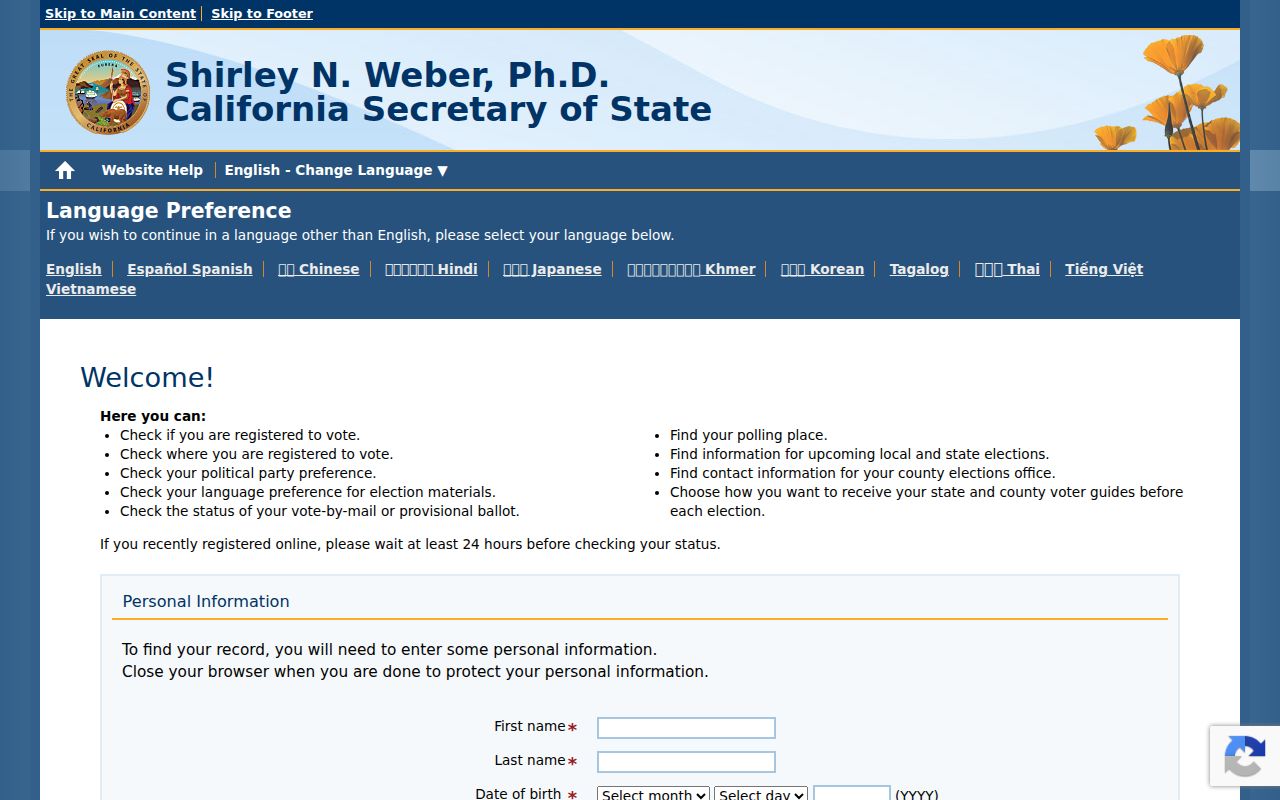
The voter-status image belongs in a careful Folsom residents directory workflow because it shows identity verification rather than a name-and-address browse. Ballot choices are never part of the public voter-record inventory.
Follow a Folsom Business or License Trail
Some resident questions are really affiliation questions. California bizfile searches corporations, limited liability companies, and limited partnerships by entity name or number. A result can show legal name, entity number, type, status, formation date, jurisdiction, agent for service, principal or mailing address, and public filing images. A registered agent or business address identifies a filing connection, not a private household.
Professional-license searches can narrow a name by board, license type, number, city, county, or ZIP when a participating board exposes those fields. The result may show status, issue or expiration dates, a public address, and discipline links. County fictitious-business-name filings add a local registrant and filing-date trail. Match an entity or license number before treating similar names as the same person.
The California bizfile business search shows the official filing route for an entity-based Folsom resident lookup. Search punctuation variants, former names, and the entity number, then compare the filing address with a deed, permit, or court record only when the record roles align.
The bizfile image marks a business affiliation path, not a household directory. The State Controller’s unclaimed-property search can add an old reported city or address, but a match is an historical lead rather than proof of current residence.
Folsom Custody and Registry Records Need Context
Custody and registry sources are time-sensitive public snapshots with special limits. Sacramento County Sheriff Inmate Information can show current custody details such as booking, facility, charges, bail, or court data where the service exposes them. Allegations are not convictions. A state incarcerated-person locator, federal custody locator, victim-notification service, and California registry add separate search paths with different names, fields, and update delays.
California’s Megan’s Law search can use a name, map or address mode and carries an explicit warning against harassment or misuse. Folsom Police Records handles incident and traffic-report requests through its records instructions, subject to active-investigation, victim, juvenile, and privacy exemptions. The non-emergency line is for procedure, not emergency reporting.
The Sacramento County Sheriff inmate information page is the official county custody starting point. A booking roster should be read with its time stamp and record role, not used as a general Folsom residents directory.
The custody image shows why a roster needs context. It answers a current custody question within the Sheriff’s system and does not establish a person’s home, family, or long-term location.
For a registry or custody result, preserve the exact name, search mode, date checked, facility or status field, and any warning shown by the custodian. That record discipline reduces namesake errors and keeps a sensitive lookup tied to its lawful purpose.
Historical Folsom Resident Directories
Historical Folsom resident directories are strongest when they are paired with the Sacramento Room’s local-history shelf. The collection includes city, county, and telephone directories, street and neighborhood pamphlet files, maps from the 1880s through the early 2000s, regional yearbooks, photographs, manuscripts, organizational periodicals, and ephemera. The landing page does not list exact Folsom-only year runs or publishers, so title-level claims need staff and catalog confirmation.
A directory entry can place an adult at a house number during the compiler’s period, show an occupation or business, record a spouse or widow notation, and sometimes distinguish an owner from a renter. Reverse or criss-cross sections arrange streets and house numbers and can bridge a name search to an address. They do not prove a deed, every household member, or an exact move date.
Gold Rush settlement, railroad development, mining camps, and the prison created several historical vocabularies. Folsom sits east of Sacramento along the American River and Lake Natoma, with US 50 separating the established city from newer Folsom Ranch development. A Folsom search may need Sacramento County, Mormon Island, Negro Bar, railroad, mining, or prison terms instead of the modern city label. The dedicated Folsom city directory collections page keeps the shelf and entry-reading work together, while the modern parcel trail remains a separate address question.
The Sacramento Archive Bridge for Folsom Records
Digital coverage changes by record series. Sacramento Superior Court sends pre-1937 family files to the Center for Sacramento History, while pre-1989 criminal indexes remain on courthouse microfiche. The modern court portal, historical Civil and Probate search, county Recorder indexes, Parcel Viewer, and Folsom permit portal therefore form separate pieces rather than one seamless database.
The Center for Sacramento History finding-aid route is useful when a person appears inside a government, business, association, railroad, prison, or family collection rather than in the collection title. Search by Folsom, street, subdivision, family surname, creating agency, railroad, and prison. Record the collection number, series, box or folder, date span, access restriction, and reproduction rule before a visit.
California State Archives catalogs and county holdings can add government, military, land-grant, trademark, and institutional context. Local history museum and historical-society files add photographs, oral history, business, railroad, prison, and family context. Newspapers, cemetery records, church registers, probate, and census schedules can fill gaps where a directory never listed the person.
Story from the record trail. Folsom’s archive handoff is the bridge across the digital divide. A modern search that ends at a missing index may still continue through a named archive series, a microfiche year, a library pamphlet file, or a released census schedule.
Protected Folsom Addresses Stay Out of Public Results
California public-record rules do not turn every address into a public resident directory. Safe at Home gives qualifying survivors and specified reproductive-health workers a substitute mailing address and confidential voter registration. Those program records are not public absent authorized government, law-enforcement, or court access. Voter identifiers, DMV residence data, utility accounts, and many protected court and vital records have separate limits.
Public-record custodians can redact unlawfully recorded Social Security numbers and certain protected information. A valid deed is not erased merely because it is inconvenient. Commercial compilation services may combine stale or misattributed data, so a correction at an official custodian does not instantly correct every downstream copy.
Lawful personal use. Folsom records are available for careful, lawful research. Do not use a name, address, roster, or map to stalk, harass, threaten, or harm anyone.
California’s Safe at Home confidentiality program is the correct route for eligible participants who need a substitute address. For other privacy concerns, minimize identity data in requests, use official correction or opt-out channels, and preserve confirmation numbers without publishing protected details.
Request Missing Folsom Records Under CPRA
When a portal does not show an existing record, the California Public Records Act provides a focused request path under Government Code sections 7920.000 through 7931.000. A request should identify the custodian, record type, date range, address or APN, name variants, and desired fields. The law asks agencies to make records promptly available and generally requires a determination within 10 calendar days, with a written 14-day extension for specified unusual circumstances.
CPRA is a records-access process, not a request for research or a new resident list. The agency may ask clarifying questions, identify the technology or location holding the records, segregate exempt portions, and estimate production for archived or voluminous material. Direct duplication costs can apply, while search and review time is generally not charged unless another statute authorizes a fee.
- Name the department or custodian, such as City Clerk, Building, Planning, Police, Assessor, or Elections.
- Describe one existing record set and a narrow date range rather than asking for everything about a person.
- Provide an address, APN, document number, case number, permit number, or precise name variant when available.
- Ask for electronic native format and rolling production when that will reduce delay.
- Keep the confirmation, exemption explanation, estimated production date, and any correction route.
Read a partial response as a record of what was released and withheld, not as proof that no other source exists. Counter indexes, archive finding aids, library collections, and the custodian’s copy desk remain valid fallback channels. A precise request is the final link in a reliable Folsom residents directory workflow.