
Folsom City Directory Collections by Type
The Sacramento Room is the principal public shelf for Folsom and Sacramento County address history. Its landing page confirms the record classes, but it does not enumerate an exhaustive Folsom title list. The honest coverage statement is therefore “title-level years not on landing page” for the city, county, telephone, and reverse directory rows below. A catalog or staff worksheet is needed before a precise year or publisher claim is made.
Several companion sets broaden the search. Maps help with street names and subdivisions. Sanborn sheets help with building footprints and historical numbering. Yearbooks, newspapers, census schedules, finding aids, and State Archives records add people who never appeared in a directory. Access differs by collection, and some databases require a library card or onsite authentication.
| Collection | Years | Where held | Access |
|---|---|---|---|
| Sacramento city, county, and telephone directories | Title-level years not on landing page | Sacramento Room | Onsite research; confirm title and call number |
| Reverse or criss-cross directory sections | Title-level years not on landing page | Sacramento Room and related local-history holdings | Inspect the selected volume in person |
| Digital Sanborn Maps | Database spans 1867-1970; exact Folsom sheets must be checked | Library genealogy databases | Library-card or resource access rules apply |
| Regional school yearbooks | 100+ titles; individual years need the title list | Sacramento Room | Onsite; title and year confirmation needed |
| Newspapers.com World Edition | Overall database coverage 1690-2025; local inclusion must be checked | Library resource page | Library-card and access rules differ |
| Released census schedules | 1790-1950 | Library databases and NARA | Households only at the census reference date |
| Center for Sacramento History collections | Collection-specific | Archive and finding aids | Box, series, and restriction review required |
This coverage table avoids a false complete run. The absence of a title-level year on a landing page is a research gap, not evidence that a volume never existed. Record the exact title, printed date, geographic scope, reverse section, missing volumes, and reproduction rule after staff confirmation.
Note: Exact directory years remain unverified until a title, publisher, printed date, and local call number are checked with Sacramento Room staff.
The Sacramento Room Holds Folsom City Directories
The Sacramento Room is at the Central Library, on the second floor of the 1918 Carnegie room. No appointment is required, although advance email helps staff retrieve vault items. Directories, maps, street and neighborhood pamphlet files, photographs, manuscripts, organization periodicals, and ephemera are onsite-use materials. Vault material is produced one item at a time for a researcher with a library account.
For a Folsom city directory visit, photograph or transcribe the title page, publisher or copyright page, abbreviation key, geographic scope, and one representative alphabetical and street-order entry. Flash-free photography is allowed. Staff copies depend on condition, and high-quality scans use a fee request process. These steps preserve the context that makes a name entry interpretable later.
The Sacramento Room local-history collection description shows why the shelf matters for address history. Its maps run from the 1880s through the early 2000s, which can help connect a printed directory street to a later parcel or an older neighborhood name.
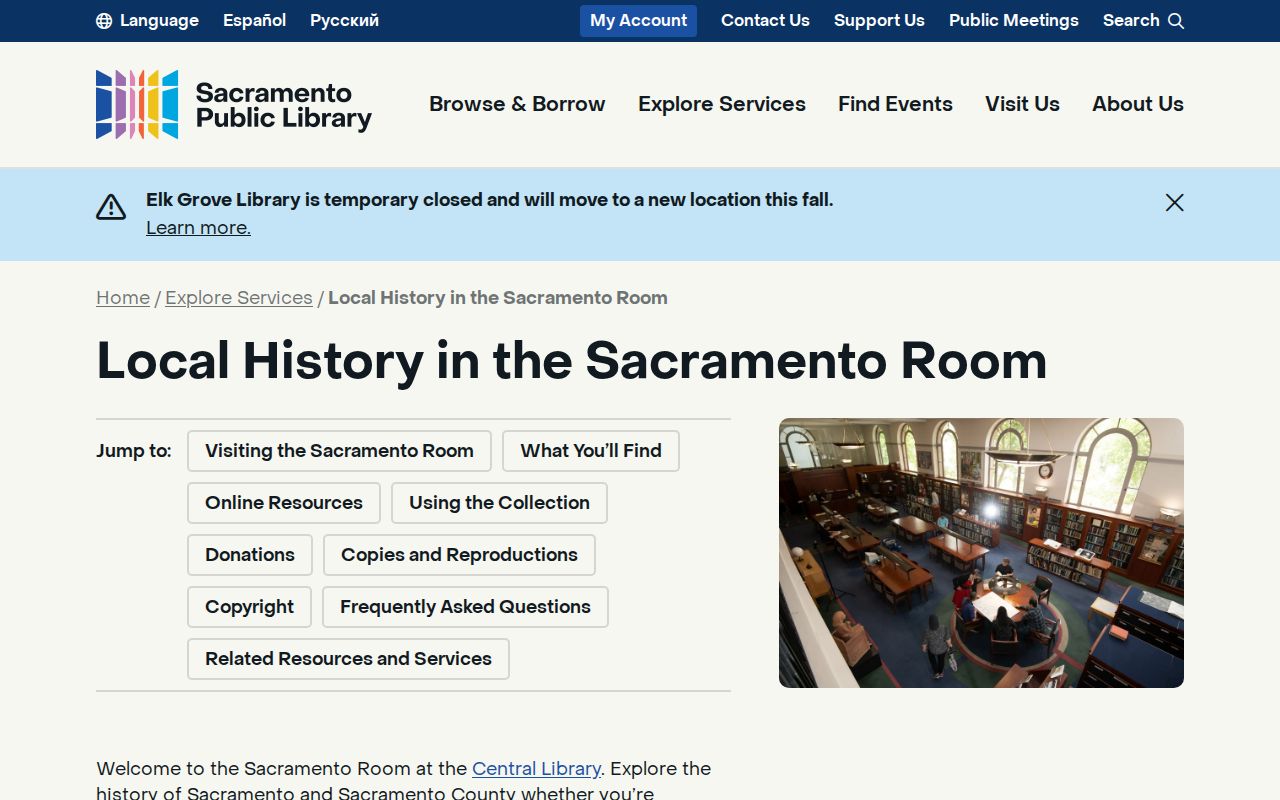
The Sacramento Room image points to the physical collection where Folsom city directory titles, maps, yearbooks, and pamphlet files can be inspected with their front matter intact.
Ask staff for headings under the street, subdivision, neighborhood, and developer names. Also request the yearbook title list, photograph index, Folsom Telegraph holdings, manuscript collection names, and organization newsletters. A surname may be easier to find inside a business or association file than in a directory title.
Folsom City Directory Databases and Maps
Licensed genealogy resources add search depth without replacing the local shelf. Sacramento Public Library lists Ancestry Library Edition, HeritageQuest, Digital Sanborn Maps, Fold3, American Ancestors, and Newspapers.com World Edition. HeritageQuest includes census, city directory, probate, and wills material within its larger record set. Digital Sanborn’s database spans 1867-1970, but the exact Folsom sheet and town label must be checked.
Database access can depend on a library card, branch location, or current resource rule. A search result should record the database name, collection, image or page, historic town label, and search variant. Sanborn maps are building and street evidence. They do not identify every occupant, and a directory index is not a deed.
The Sacramento Public Library genealogy resource list identifies the database group used for Folsom city directory, census, newspaper, probate, and map research.
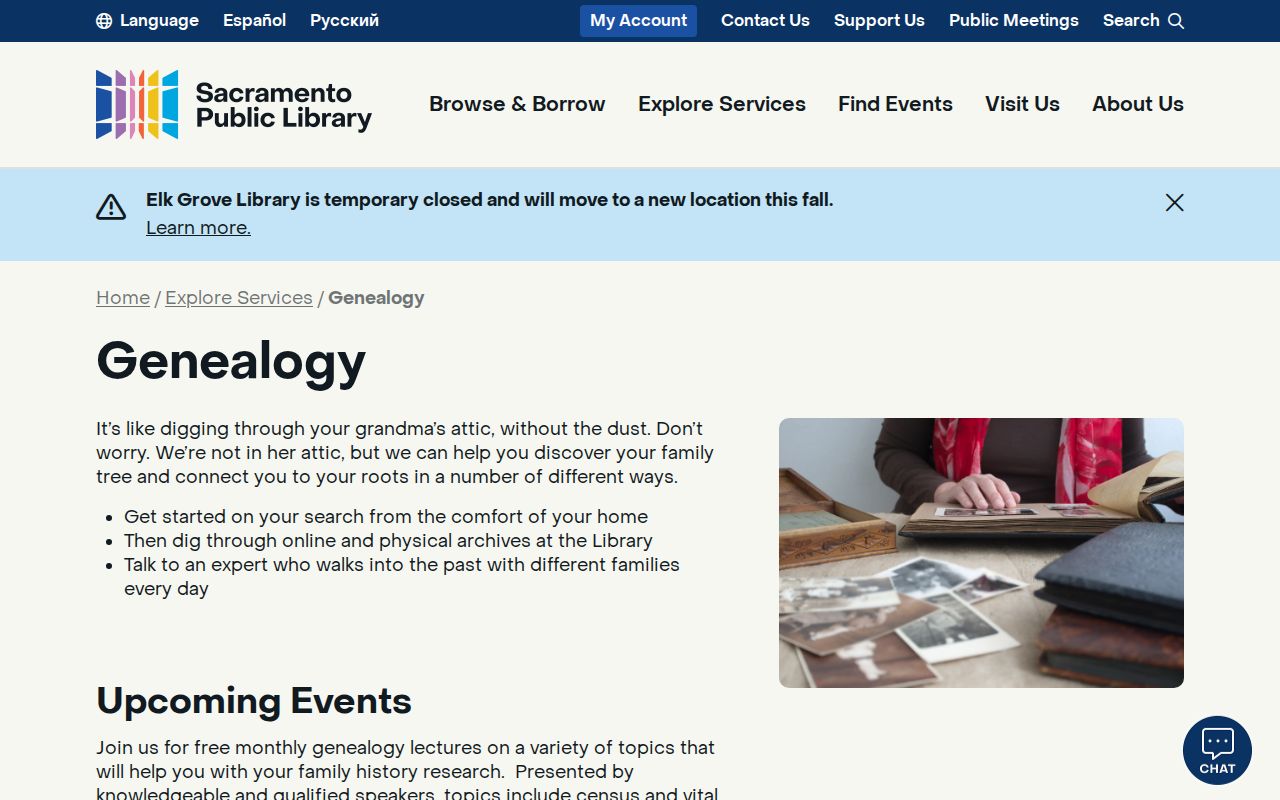
The genealogy image connects a Folsom city directory search to the library’s licensed databases. Access conditions differ, so preserve the collection name and the route used to reach the result.
For an older Folsom resident, search the modern city name along with Sacramento County, Mormon Island, Negro Bar, railroad, mining, and prison terms. Older sources may use initials, abbreviated given names, a spouse’s name, or a former settlement label.
Reading a Folsom City Directory Entry
A Folsom city directory entry is a compact snapshot assembled before publication. It may associate an adult with a residence, occupation or trade, a business connection, spouse, telephone, and sometimes an owner or renter mark. The exact fields vary by volume. Do not transfer a symbol or abbreviation from one edition into another without checking its front matter.
Read the entry from the name outward, then test it against the street section, a map, a deed, census schedule, newspaper notice, or obituary. A directory can show that a compiler placed someone at an address during the covered period. It cannot prove title, every person in the household, or a precise departure date.
| Name | Surname, given name or initial, and variant spelling to preserve for the next search. |
|---|---|
| Spouse or widow notation | Relationship clue that may connect a household across editions. |
| Occupation or trade | Historical affiliation or trade listed by the compiler, sometimes with a business address. |
| Residence | House number and street, with local abbreviations that need the volume key. |
| Telephone | Present in some editions; treat it as a period clue, not a current contact. |
| Owner or renter mark | Only when the selected edition defines one; preserve the symbol and its key. |
- Criss-cross section
- The street-order half of a directory, arranged by street and house number rather than surname.
- Householder index
- A name-centered list that can help locate an adult or household head before checking the street pages.
- Abbreviation key
- The front-matter explanation for residence, boarding, spouse, business, street, and other marks.
- Compiler date
- The period when entries were gathered, which can precede the cover year or publication date.
Reverse Sections in Folsom City Directories
Reverse sections turn a Folsom city directory into an address tool. Search the street guide for a house number, capture every listed occupant or telephone clue, then return to the alphabetical section to test spelling, spouse, trade, business address, and neighboring entries. The street section can reveal how an older volume organized a block even when a current address search uses a different format.
Use a map before deciding that a missing street entry is a missing person. Folsom maps in the Sacramento Room cover several generations of street and subdivision change. A street name may be abbreviated, a number may be recorded in an older form, or a historic settlement may be indexed under Sacramento County rather than the modern city label. No verified citywide renumbering year was found, so address bridges must be documented one property at a time.
For modern parcel, deed, and permit work, the Folsom street directory by address follows the APN chain. The city directory shelf remains the source for how to read the historic reverse entry itself.
Folsom Family History in Yearbooks and Newspapers
Yearbooks, directory entries, and obituaries can reconnect classmates or document a family without treating any one source as current proof. The Sacramento Room holds more than 100 regional yearbook titles, with the exact title list available by request. A yearbook portrait or activity line can test whether two directory entries refer to the same person when paired with address, spouse, or trade clues.
Newspapers add notices, obituaries, school and community activity, business advertisements, and address changes. Search the Folsom Telegraph and regional papers through licensed library databases or microfilm. Cemetery and interment records, church registers, probate, and death certificates can explain why a name disappears. A disappearance alone does not prove a death or a move.
For a modern identity question that grows out of a historical entry, preserve the old source citation first, then use a separate Folsom resident lookup to compare current official records. Historical context should remain distinct from present status.
Folsom City Directory Finding Aids and Archives
The Online Archive of California helps locate collection-level and series-level descriptions. Search “Folsom,” a street, subdivision, business, railroad, prison, family surname, or creating agency. Open the finding aid and record the collection number, series, box or folder, date span, access restriction, and reproduction policy. A resident may be inside an organization or government collection even when the person’s name is absent from the title.
The Center for Sacramento History finding-aid index is the discovery route for older city and county records, photographs, maps, and donated community material.
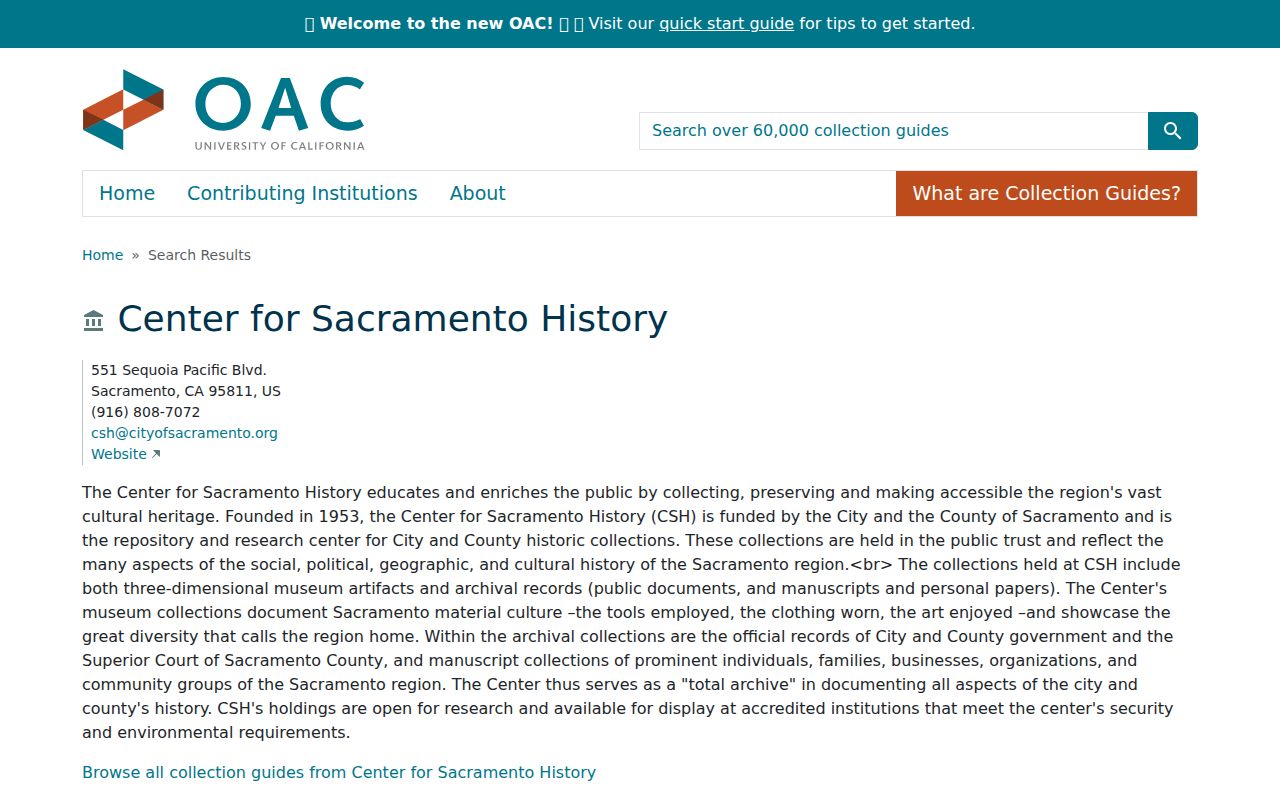
The finding-aids image shows the collection-level route. It does not mean that every described item is digitized or immediately open.
The Center for Sacramento History is also the destination for pre-1937 family files referred from the court. Search the archive before travel and ask about boxes, dates, restrictions, and reproduction. Local museum and historical-society files add Folsom photographs, oral history, family, business, railroad, mining, and prison context.
The Center for Sacramento History home collection information supplies the institutional context for those archive searches.
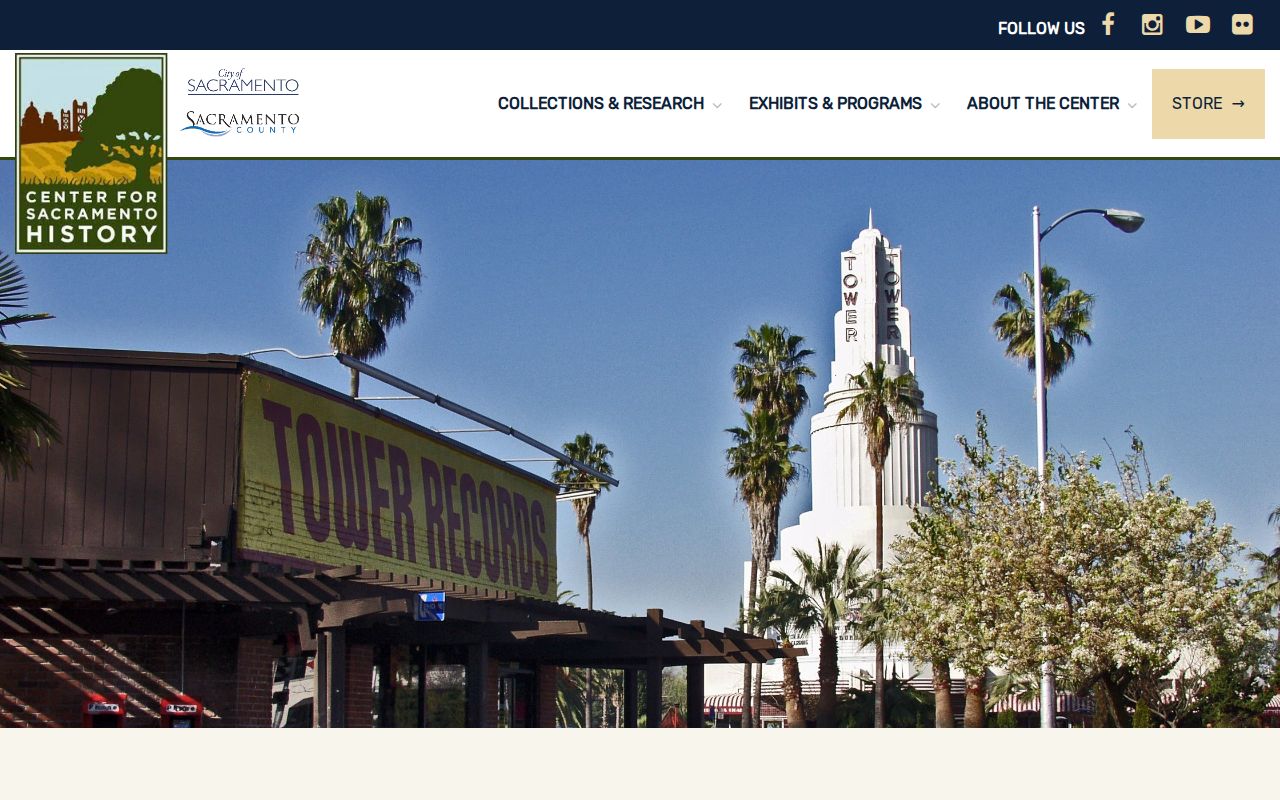
The Center image belongs between the finding-aid steps and the state-level route because its donated and government collections bridge local directory gaps.
California State Archives catalogs add state government, military, land-grant, trademark, and county-related holdings. Its catalog and Online Archive of California finding aids are discovery tools; boxes or series must be requested by their citations when a name is not digitized.
The California State Archives catalog and access information provides the state-level route for an institutional or government record that the Sacramento shelf does not hold.
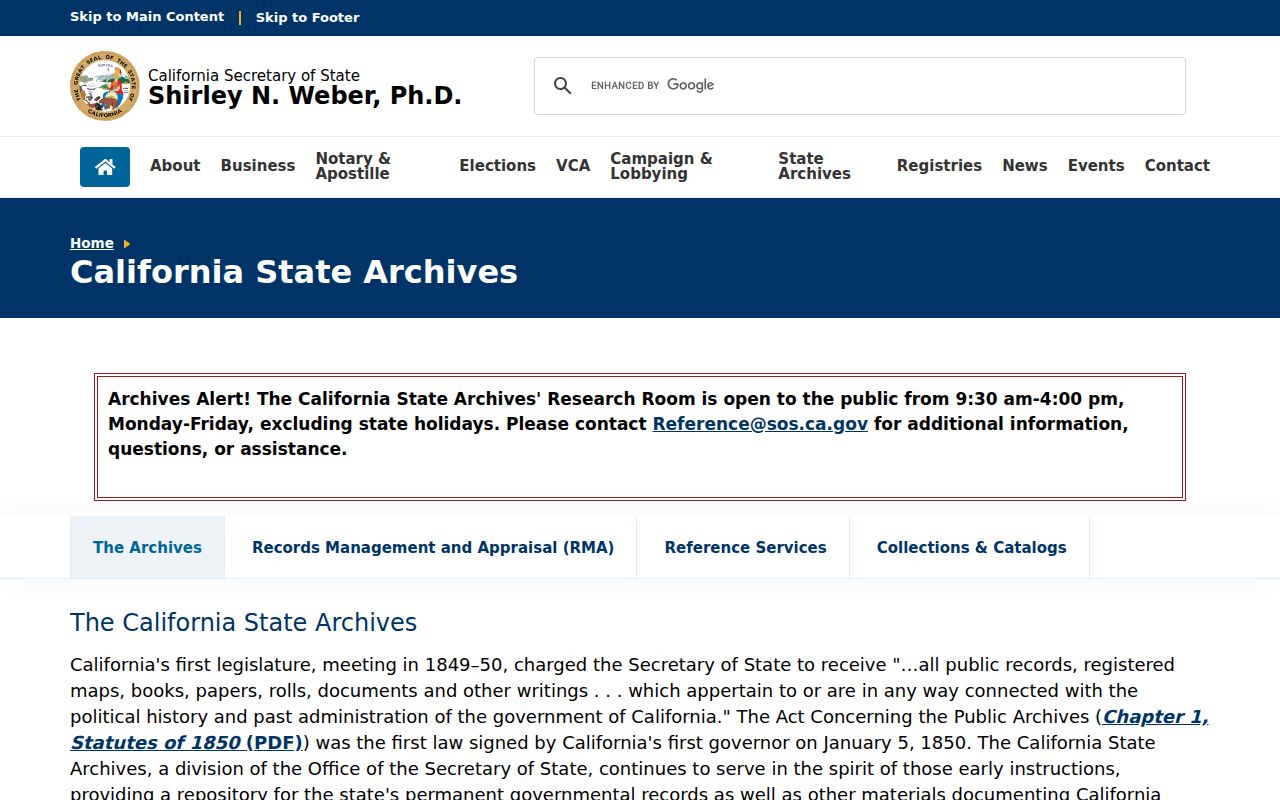
The State Archives image closes the local-to-state finding-aid chain. Record restrictions and reproduction rules before relying on a collection for a family conclusion.
Note: A finding aid describes custody and scope; it does not guarantee digitized images or unrestricted access to every described item.
Trace a Folsom Household by Directory Year
A household trail is built one edition at a time. Start with the strongest address and spelling, then keep a timeline with columns for date, source, indexed person, role, address form, APN or legal description, and confidence. Pair directory years with released census years rather than treating the directory as a continuous roll.
- Find the first plausible appearance in the selected alphabetical or householder section and copy the complete entry.
- Move forward or backward one available edition at a time, recording address, spouse, trade, telephone, and any owner or renter notation.
- Use the reverse section to test the house number, neighbors, street abbreviation, and cross-street clues.
- Pair the directory with the 1950, 1940, 1930, and earlier released census schedules, noting that each census covers one reference date.
- Close a disappearance with an obituary, cemetery record, probate file, deed by a trustee or executor, or a later address, without inferring the cause from absence alone.
Directory compilers could omit non-subscribers, minors, some women under historical conventions, and rural addresses. The first or last appearance is therefore a bracket, not an exact move date. Compare occupation or trade, spouse, street, and historical settlement terms before merging names.
When a historical entry needs a present-day check, use a separate official record path and preserve the old citation. A city directory can establish historical placement while a deed, voter status, vital record, or court index answers a different question.
Gold Rush and Prison Terms in Folsom Directories
Folsom’s record history has more than one place name. Gold Rush settlements, the Sacramento Valley Railroad terminus, mining activity, and the state prison shaped how residents appeared in records. Earlier people may be indexed under Sacramento County, Mormon Island, Negro Bar, railroad, mining, or prison contexts rather than “City of Folsom.” Search each vocabulary beside a surname, street, business, or institution.
Folsom State Prison opened in 1880, and institutional collections can include photographs, rosters, publications, or records with access limits. Do not infer whether a person was incarcerated, staff, a visitor, or a nearby resident from a name or address alone. Match the person to the collection’s stated role and date.
Local-history story. The city directory trail is a record of changing geography as much as a list of names. Railroad, prison, mining, and later suburban terms can point to different shelves, maps, and archive series for the same family.
Confirm the Folsom City Directory Run with Staff
The official Sacramento Room landing page does not expose exact Folsom-only title runs, publishers, missing volumes, or a confirmed last printed year. That research gap should be stated plainly. Ask staff for exact title, publisher, printed date, geographic coverage, alphabetical and reverse sections, telephone inclusion, call number, physical or digital format, missing issues, and reproduction rules.
Use the dates below as record-history anchors, not as directory publication claims. They explain why a Folsom name may move between county, city, state, court, and institutional vocabularies.
| Anchor date or span | What it frames | Research use |
|---|---|---|
| 1850 | Sacramento County was one of California’s original 27 counties. | Earlier deed, court, tax, and settlement searches may use county terms. |
| 1880 | Folsom State Prison opened. | Institutional and prison-history vocabulary may surface alongside family records. |
| 1880s through early 2000s | Sacramento Room map coverage. | Bridge street names, subdivisions, boundaries, and address continuity. |
| 1946 | Folsom incorporation. | Separate later municipal records from earlier county or settlement references. |
| Directory title years | Not enumerated on the collection landing page. | Confirm volume by volume with the catalog or Sacramento Room staff. |
That last row is the key quality safeguard. A well-cited Folsom city directory entry includes title, publisher, printed year, page, section, abbreviation key, and the source location. If a volume has not been inspected, describe it as a possible collection lead rather than a verified year run.