
Folsom Previous Residents by Era
A useful Folsom address history starts with the current parcel and then moves through sources that cover different kinds of people. The Sacramento County Assessor Parcel Viewer supplies the APN, situs, map context, and current assessment clues. The Sacramento County Clerk/Recorder index follows title parties and recorded instruments. Sacramento Room directories, census schedules, maps, permits, obituaries, and probate add household or event evidence that a deed cannot provide.
| Source | Years It Covers | Where Held | What It Shows |
|---|---|---|---|
| Modern parcel roll | Current annual roll | Assessor viewer, secured roll counter, or NextRequest | APN, owner, mailing and situs fields, values |
| Recorder index and books | County formation era to present; online cutoff not stated | Clerk/Recorder online index, counter, books, or images | Title parties, liens, maps, legal descriptions |
| Historical Civil cases | 1936-1995 | Sacramento Superior Court historical search | Disputes and judgments tied to parties |
| Historical Probate cases | 1948-2007 | Sacramento Superior Court historical search | Estates and heirs |
| Directories and criss-cross volumes | Exact Folsom run needs staff confirmation | Sacramento Room, onsite and database access | Occupants, addresses, occupations, reverse entries |
| Federal census | Released schedules through 1950 | NARA and library genealogy databases | Households on the census date |
| Maps and Sanborn sheets | Maps from the 1880s through early 2000s; Sanborn database span 1867-1970 | Sacramento Room and library databases | Street continuity, subdivisions, footprints, numbering clues |
| Folsom permits | Portal coverage not stated | eTRAKiT, Building Services, or records request | Alterations, applicants, contractors, dates, inspections |
Online routes are only the first pass. The Assessor web map is free, but owner names are intentionally absent online. The secured roll is available through lobby computers or an electronic request. Recorder gaps lead to Sacramento counter indexes, older media, copy requests, and archive finding aids. The library is the practical route for occupants, while court, vital, obituary, and probate records explain a name that appears or disappears.
Note: A blank result in one era usually redirects the search to a different custodian, not proof that no one lived there.
Folsom Previous Residents Start with Parcels
The Sacramento County Assessor Parcel Viewer accepts an address, APN, or map location and returns parcel geometry, jurisdiction, land-use context, assessed values, limited building characteristics, and map links. It does not display owner names. That privacy choice makes the APN the starting key rather than the final answer. A normalized situs address can locate the parcel, and a map click can help when a unit or older street spelling fails.
Public secured-roll fields include the assessed owner, property address, mailing address, values, exemptions, tax-rate area, zoning or land-use codes, parcel maps, and Recorder references. Self-service computers are available at 3636 American River Drive, Suite 200, Sacramento, Monday through Friday from 8 a.m. to 5 p.m. Electronic Assessor records can also be requested free through the County public-records request channel. Ask for the APN and public roll columns that match the house-history question.
- Situs address: the place assigned to the parcel.
- Mailing address: where the tax notice goes, which may be another residence, a PO box, a trust, or a manager.
- Recorder reference: a book/page or related clue that can shorten a deed search.
- Assessment values: annual roll facts, not a live market estimate or occupancy record.
This Assessor counter and NextRequest step is the local insider tip: the public fields exist, but the online parcel map deliberately stops before the owner. Values update in early July and mid-September, and corrections after September 15 may not appear in the same roll context.
Trace Folsom Previous Residents Through Deeds
The Sacramento County Clerk/Recorder index is a party and document index, not a perfect address search. Recorded instruments use grantor and grantee names, recording dates, document types, legal descriptions, book/page citations, and document numbers. Start with the APN and current secured owner, then let each seller name point to an earlier transaction. Deeds, deeds of trust, reconveyances, liens, releases, and maps show recorded interests, not proof that every named party lived at the property.
- Pull the current APN and secured owner or mailing information from the Assessor. Save any Recorder book/page clue and the legal description.
- Search the current owner as grantee in the Recorder index. Bracket the likely acquisition period and try surname variants or initials.
- Record the grantor, recording date, document number, document type, book/page, and legal-description clues from the matching result.
- Search that grantor as an earlier grantee, then repeat the same handoff backward through each matching deed.
- When the online series ends, use office or authorized-vendor image access, Sacramento counter terminals, older index media, bound books, microfilm, or a document-number copy request.
- Grantor and grantee
- The grantor transfers an interest. The grantee receives that interest.
- Chain of title
- The linked sequence of recorded transfers for the same described property.
- Legal description
- The lot, block, subdivision, or other land description that identifies the property more reliably than an old street string.
- APN
- The county parcel number used to connect assessment and map records; it is not itself a deed.
The public landing page does not state one universal online cutoff for every document series. Do not invent a cutoff year. A narrow CPRA request can seek an existing index or roll dataset, but it cannot require the Recorder to perform a chain-of-title analysis. A plain copy is useful for research; certification and recording fees are separate, so confirm the current Recorder fee schedule before ordering.
Folsom Address Continuity for Past Residents
Situs, mailing address, postal city, jurisdiction, and legal description are different keys. The situs locates a parcel. Mailing address locates the tax-notice recipient. A legal description can keep the chain intact after a street name or house number changes. An assessor map line is an assessment graphic, not a survey or final legal boundary.
Postal labels add a Folsom-specific trap. ZIP 95630 serves the principal Folsom delivery area, 95671 is a Folsom PO Box ZIP, and 95763 serves newer south-of-US-50 Folsom growth. The USPS ZIP Code lookup verifies one address at a time, while Folsom planning and GIS maps help test city or planning geography. “Folsom” in a postal line does not by itself prove incorporated-city jurisdiction.
- Compare the old street wording with Sacramento Room maps from the 1880s through early 2000s.
- Use Digital Sanborn Maps, whose database span is 1867-1970, for footprints and numbering clues.
- Preserve both old and current address forms beside the APN, subdivision, or legal description.
- Do not assign a citywide renumbering date: no verified Folsom-wide year was located.
That comparison keeps a former household from being lost because a directory, permit, or newspaper used a different street form. It also prevents a postal route from being mistaken for the boundary used by the City or County.
Pair Folsom Previous Residents with Census Years
The Sacramento Room is the principal public collection for Folsom and Sacramento County address history. Its inventory confirms city, county, and telephone directories, street and neighborhood pamphlet files, maps, photographs, manuscripts, organization periodicals, and regional yearbooks. The official landing page does not enumerate exact Folsom-only directory years or publishers, so a title-level run must be confirmed with staff. The historical collection itself is described on the Folsom city directory page.
A criss-cross or reverse directory arranges entries by street and house number instead of only by surname. It can connect an address to an occupant or telephone listing, but it is a dated snapshot. A directory may omit non-subscribers, minors, rural addresses, and people represented through historical household conventions. Library access is onsite; no appointment is required, advance email helps with vault material, one item is produced at a time, and photography without flash is allowed when condition permits.
- Write down the current address, APN, subdivision, and every known old address form.
- Use the newest available alphabetical and reverse directory, recording each adult, address, occupation, and telephone entry.
- Move backward one issue at a time and mark the first and last appearance at the address.
- Search the alphabetical section for a moved address, then pair the result with the nearest released census year.
- Use deeds to separate an owner from an occupant, and use newspapers, obituaries, or probate when a name leaves the record.
Released federal census schedules run through 1950 under the 72-year release rule. Ancestry Library Edition, HeritageQuest, Digital Sanborn Maps, Fold3, American Ancestors, and Newspapers.com World Edition are licensed resources whose card or location rules differ. The library genealogy resource page identifies those access conditions. Do not treat a census household as a complete list for every year between schedules.
Folsom Previous Residents and Permit Clues
Folsom eTRAKiT provides public inquiry modes for permits, projects and planning, inspections, and properties. An address search may show an applicant or contractor, permit number and type, work description, issue or status dates, and inspection events. Applications require an account, and the portal’s full historical coverage is not stated. A permit can date an alteration or identify a work participant, but it does not by itself establish title or occupancy.
| eTRAKiT field | Type | Use in an address history |
|---|---|---|
| Search module | Tabs or menu | Permit, Project, Property, or Inspection |
| Search by | Dropdown | Number, site address, or contractor/owner where enabled |
| Search text | Text | Try a partial address without unit punctuation |
| Start and end date | Date pair | Narrow a large result set |
| Status and inspections | Result fields | Place work in a dated sequence |
When a public result is missing, request existing Building, Planning, or Code Enforcement records through the Folsom City Clerk public-records channel. Give the address or APN, department, date range, and desired record type. Plans can contain protected security or copyright material, and complainant or sensitive personal data may be withheld. Permits expire two years after issuance, so an expiration rule should not be read as proof that work stopped on a certain date.
Vital Records for Folsom Previous Residents
Vital records and related event records can explain the end of a household trail, but California uses authorized and informational copy classes rather than a simple age-based opening rule. Sacramento County Clerk/Recorder handles local birth, death, and public or confidential marriage certificates. The California Department of Public Health Vital Records supplies statewide applications. An informational copy is public but marked not valid to establish identity; an authorized certified copy requires an eligible requester and sworn statement.
The statewide application page is the useful starting point when the event county is known but a state request is more practical.
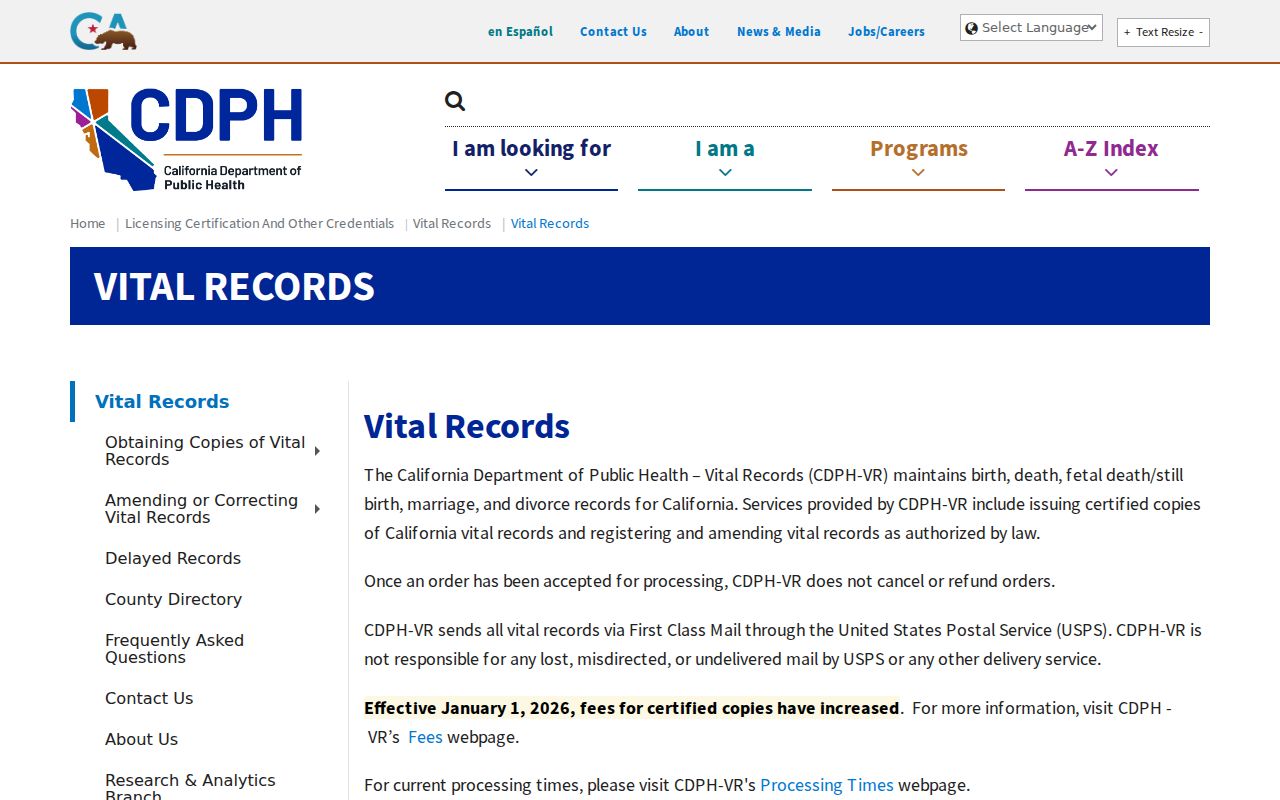
The application choices help distinguish a family-history copy from an identity-establishing authorized copy. A sufficiently specific event and fee are required, and the agency generally keeps the search fee even when no record is found.
Current state fees change, so the California vital-record fee page should be checked at the time of the request.
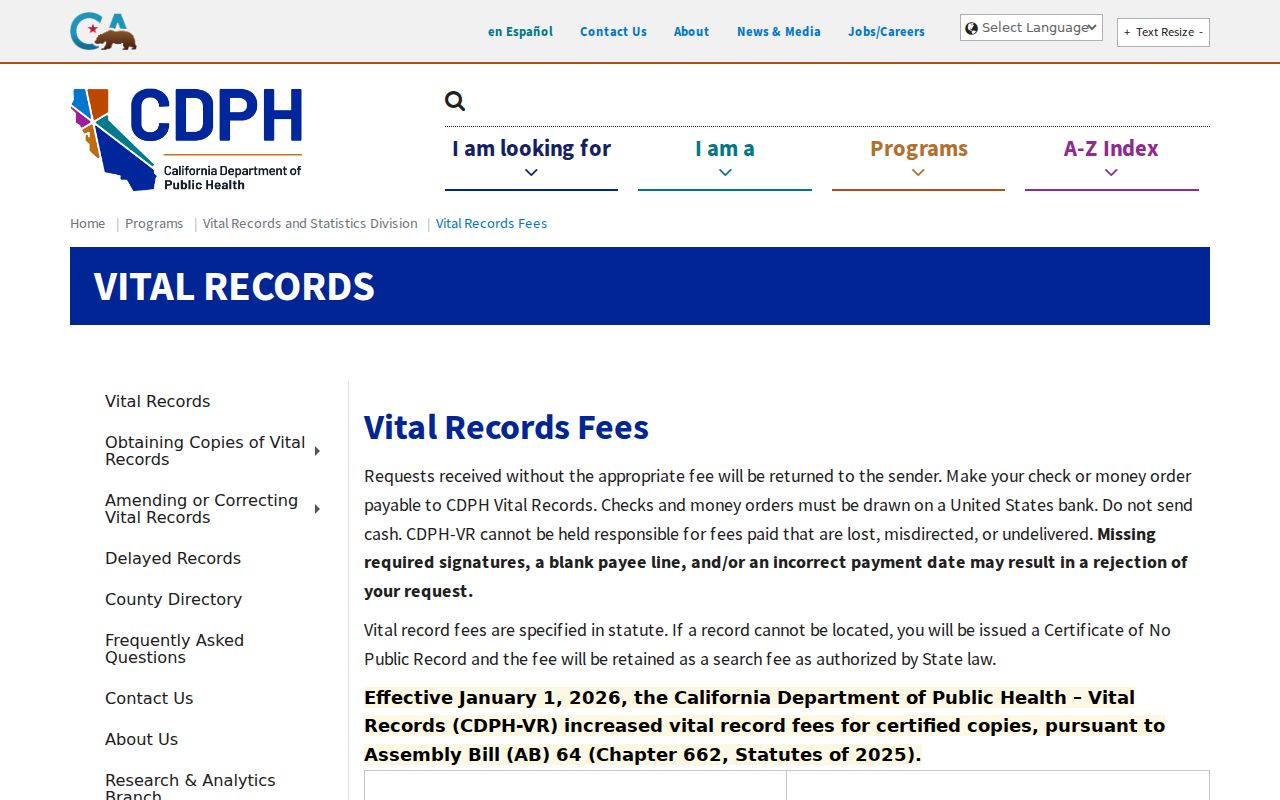
Fee information belongs to the current application, not to a claim about what an old Folsom event cost. Mail requests for an authorized copy may require a notarized sworn statement, while an informational copy does not become proof of identity.
Marriage status needs its own check. The Sacramento County marriage eligibility page explains the local ordering route and the limits on confidential marriage certificates.
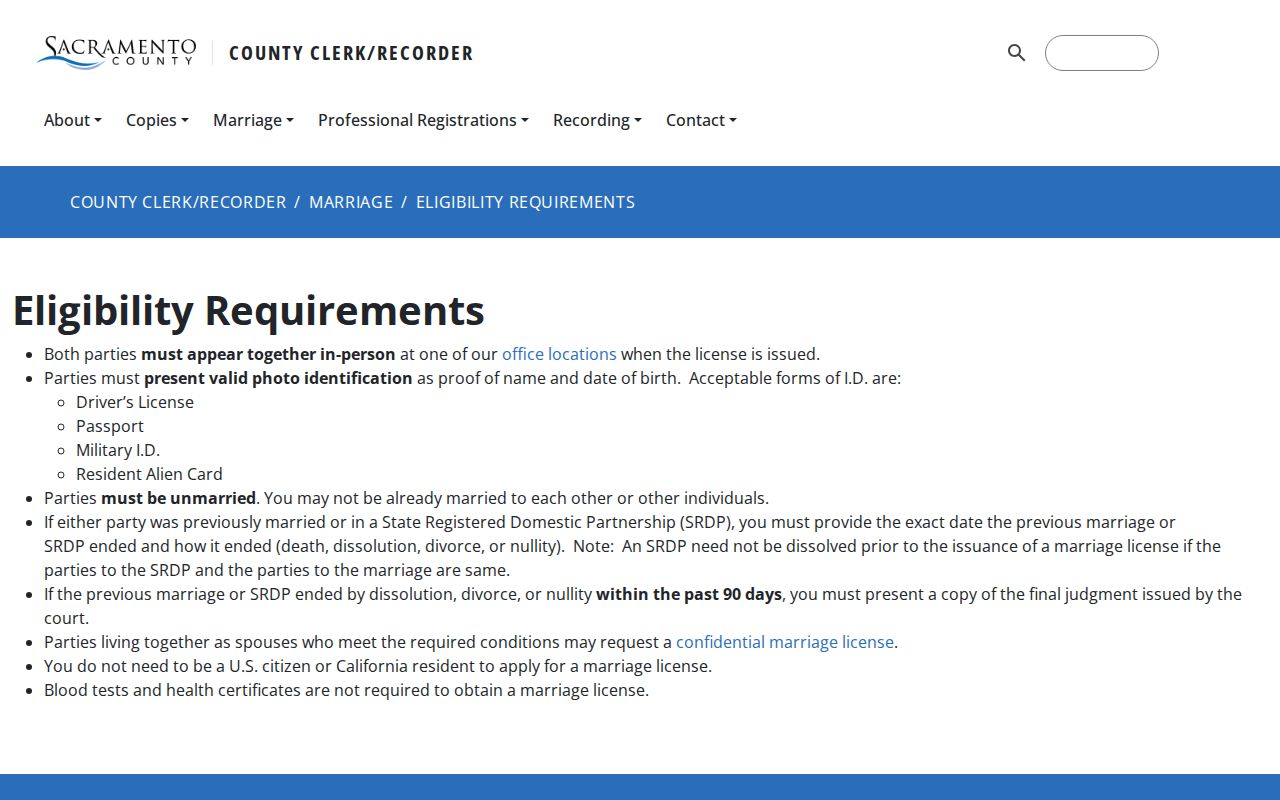
Confidential marriage records are restricted to the parties or a court order under Family Code section 509. Divorce decrees come from Sacramento Superior Court; CDPH’s statewide divorce product is a certificate of record for 1962 through June 1984, not the decree. Obituaries, cemetery records, newspapers, and probate provide historical endpoints when a certificate is unavailable.
- Search Folsom Telegraph and regional notices through Sacramento library newspaper resources.
- Use the historical Sacramento Probate search for 1948-2007, then the modern court portal outside that range.
- Check cemetery or interment records against an obituary or official certificate.
- Use adoption-information procedures and court processes for birth-family research; do not bypass confidential files.
Folsom History Bridges Earlier Residents
Sacramento County was one of California’s original 27 counties in 1850, while Folsom grew through Gold Rush settlement, the railroad, mining, and the state prison before incorporation in 1946. Older records may use Sacramento County, a township, Mormon Island, Negro Bar, railroad, mining, or prison language instead of the modern city name. That vocabulary matters when a former resident is missing from a city-keyed search.
Digital coverage is split. Pre-1937 family files are referred to the Center for Sacramento History, pre-1989 criminal indexes remain on courthouse microfiche, and historical Civil and Probate searches cover only their stated eras. The Online Archive of California finding aids and the Center for Sacramento History help identify series, date spans, restrictions, and reproduction rules. State archive catalogs add state and county-related holdings that are not all digitized.
Sacramento Room
Directories, maps, yearbooks, street pamphlets, photographs, manuscripts, and organization periodicals for onsite research.
Center for Sacramento History
Older city and county government files plus community collections located through finding aids and archive requests.
California State Archives
State and county-related records, catalog discovery, and series-level access for names not exposed online.
No courthouse fire or wholesale Sacramento County deed loss was found in the reviewed official sources. The national 1890 census loss is a real gap, so deeds, tax material, maps, newspapers, directories, cemetery records, and probate carry more weight for that period.
Separate Folsom Residents from Owners
Previous residents are best described with the exact role a source supports. A deed names a party to a recorded transfer. The secured roll names an assessed owner and tax-mail destination. A directory associates a person with an address in a particular edition. A census enumerates a household at one reference date. A permit records proposed or authorized work and its participants. None of those facts alone proves that every named person occupied the parcel throughout the interval.
- Recorded deed
- Strong evidence of a named party acquiring or transferring a described interest, not physical occupancy.
- Secured assessment roll
- Evidence of assessed ownership and mailing destination for that annual roll, not a current resident list.
- Directory entry
- Evidence that a compiler associated a named adult or business with an address in that issue, not an exact move date.
- Census schedule
- Evidence of the household counted on the census date, not every person between census years.
- Vital, obituary, or probate record
- Evidence of an event or estate relationship, not permission to infer a present location.
Keep a timeline with date, source, indexed person, role, address form, APN or legal description, confidence, and follow-up. Use two independent anchors before merging names, such as an APN and deed description or a directory address and obituary. A name disappearing from a directory is a prompt to search probate, death, newspapers, or a moved address, not proof of death.
Lawful house history. Folsom previous-resident research fits family history, property history, genealogy, and personal curiosity. Public availability never permits stalking, harassment, threats, or tracking a living person.