
Folsom Resident Lookup Coverage
A useful Folsom resident lookup begins by matching the question to the record keeper. The Sacramento County Assessor can tie a parcel to an APN and jurisdiction, but its public web map omits owner names. The Clerk/Recorder holds deed parties and legal descriptions. Sacramento Superior Court supplies the local party index, while the county and California Department of Public Health handle vital-record copies. Voter, business, license, and unclaimed-property searches add narrower clues. None is a complete resident roll, and an owner, mailing address, or filing party is not proof of who occupies a place.
| Record | What It Confirms | Where to Search | Access |
|---|---|---|---|
| Secured property roll | Named owner, tax-mail destination, parcel | Sacramento County Assessor Parcel Viewer | Viewer online; owner fields offline or by CPRA request |
| Deed index | Parties to a title transaction and prior/new owner chain | Sacramento County Clerk/Recorder | Party, date, and type search; image and copy rules vary |
| Court index | Party name, division, filing date, and public case trail | Sacramento Superior Court | Modern and historical portals; older criminal search channels |
| Vital record | Event identity and stated relationships | CDPH Vital Records or the county | Informational copies public; authorized copies restricted |
| Voter record | Personal registration and status information | California My Voter Status | Self-lookup; files require a qualified purpose |
| Business or license filing | Entity, agent, credential, status, or affiliation | bizfile and DCA Search | Official public searches |
| Unclaimed property | Older reported name, city, address, or affiliation clue | California State Controller search | Free name and city search; not current residence proof |
Start with the least ambiguous key. An address points to a parcel and jurisdiction. A known occupation or business points toward a state filing. A name paired with an event date may fit a court or vital-record index. Preserve middle initials, suffixes, former names, and spelling variants. A common name needs two independent anchors, such as an APN and a deed party or an entity number and filing address. That habit keeps a resident lookup from turning two different people into one record.
Folsom Resident Lookup: Court Fields
Folsom cases are filed in Sacramento Superior Court. The modern Public Case Access portal separates Civil, Probate, Family, Criminal, and Traffic. California has no single statewide trial-court party index, so a name search must use the local division and the right date range. Family information is limited, and parties or attorneys use an account and case subscription for expanded access.
The official California court case-lookup explanation is useful before a Folsom resident lookup because it sets expectations about local indexes and access limits.
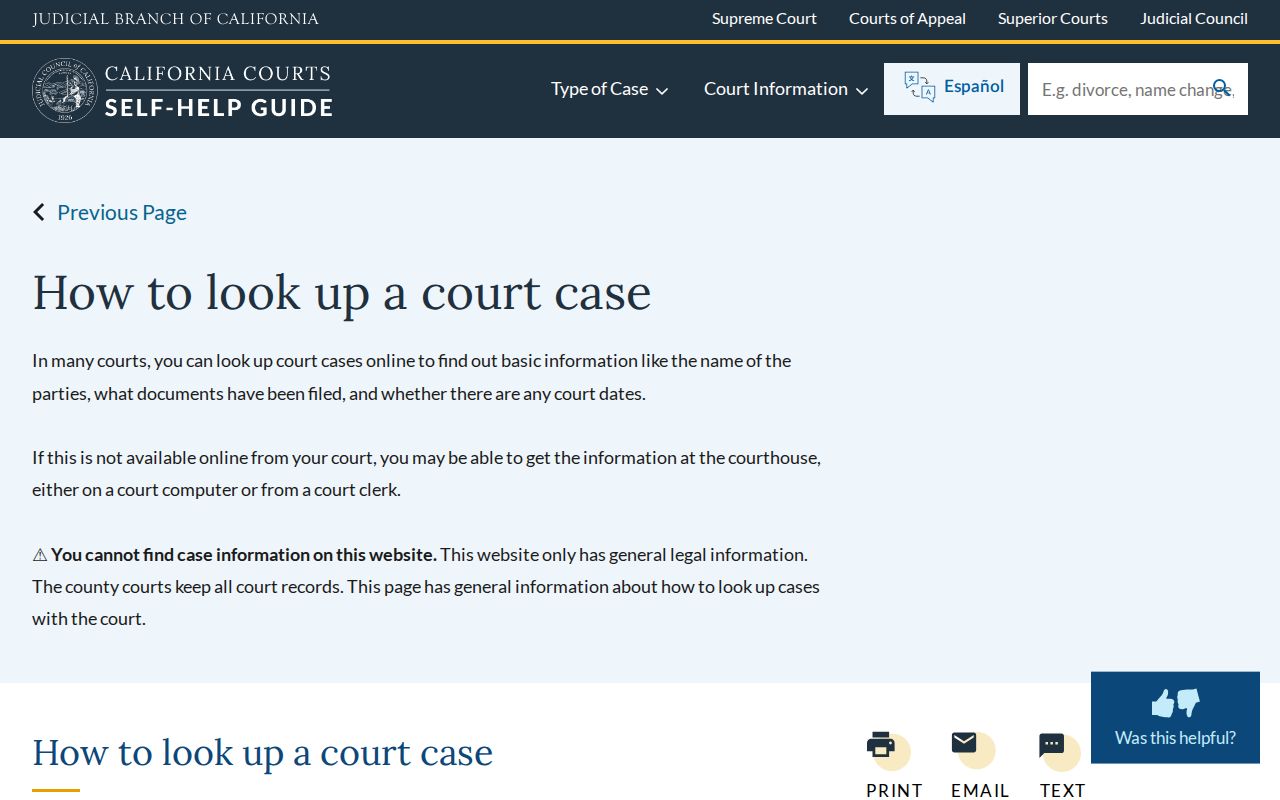
The court guide reinforces the need to search the Sacramento index, then read the result in its own record context rather than treating a name match as an identity match.
| Field label | Type | Required | Format or use |
|---|---|---|---|
| Division | Tab or menu | Yes | Civil, Probate, Family, Criminal, Traffic, or Historical |
| Last Name / Business Name | Text | Conditional | Party-name mode |
| First Name | Text | No | Narrows person results |
| Case Number | Text or year plus number | Conditional | Criminal accepts Any Format or YYYY-12345678 |
| Filing Date / Range | Date pair | Conditional | Historical browse mode |
| Search | Button | Submit | Runs the selected mode |
A court result can show the case number, caption, case type or division, filing date, parties and roles, status, register-of-actions entries, hearings, document title and date, and a public disposition when one is available. Remote documents are more limited for criminal, family, civil-harassment, and other sensitive matters. Juvenile, adoption, sealed, and fee-waiver records are not public.
Sample public result inventory:
- Case number: the court's identifier for the matter.
- Caption: the case title as filed.
- Party and role: the name's position in the case, such as petitioner, respondent, plaintiff, defendant, or interested party.
- Filing date and division: when the matter began and which Sacramento court area holds it.
- Register of actions: public entries for filings, hearings, or status events.
- Document title, date, and disposition: the public document trail and outcome when those fields are available.
Folsom Resident Lookup Across Two Court Eras
Sacramento's historical search is a key number in a Folsom resident lookup. The separate historical portal covers Civil filings from 1936 through 1995 and Probate filings from 1948 through 2007. Its modes are Search by Name, Search by Case, and Search by Filing Date. Other civil and probate cases moved to the newer portal, where public online search and document-download fees have been discontinued.
The Sacramento historical case search is the source for those date ranges and search modes.
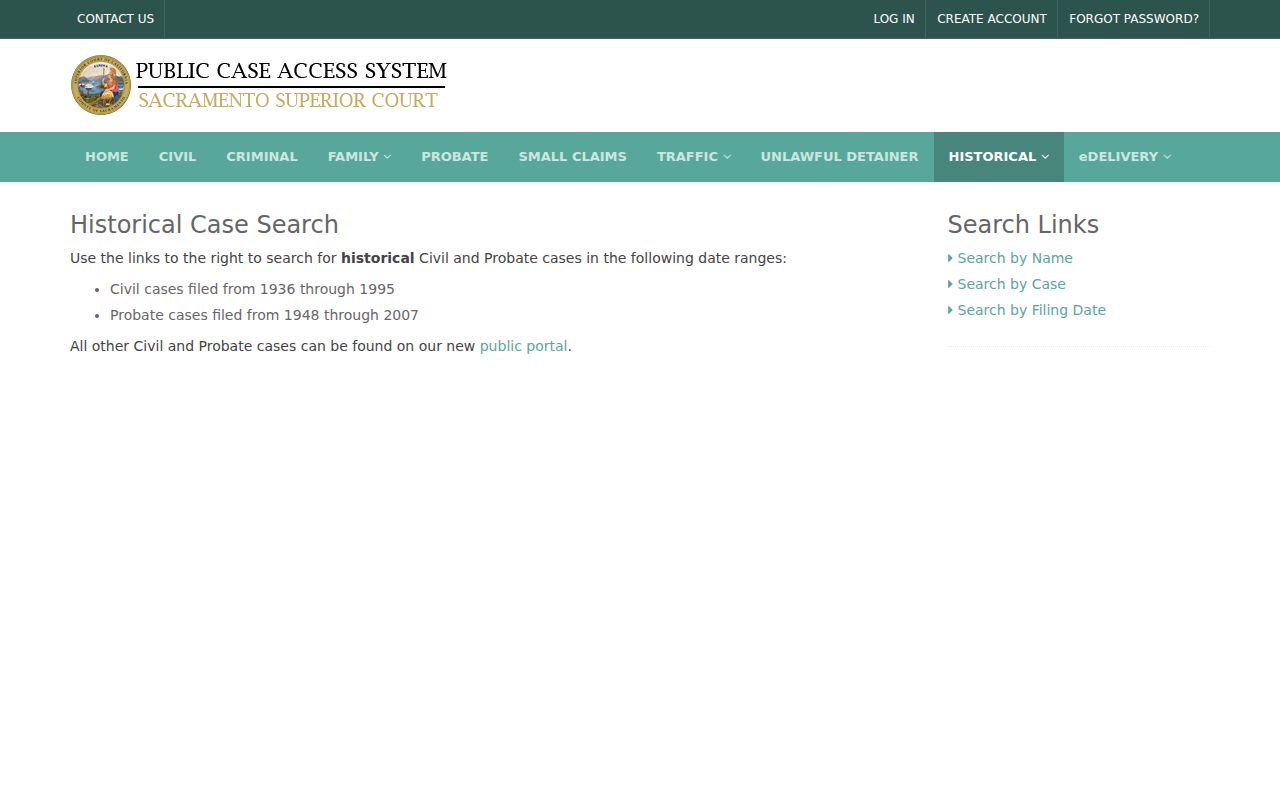
That historical split explains why a search can look empty in one portal while a case sits in the other. It also gives an approximate time box for probate heirs, older civil disputes, and name variants tied to a Folsom address.
Criminal access uses a different channel. Sacramento court staff conduct name searches for 1989 forward, while earlier cases remain on public microfiche. Criminal Records lobby kiosks are on the second floor of the Tani G. Cantil-Sakauye Sacramento Superior Court. Form CR-278A can be submitted in person, by mail, or by email to CrimRecordsRequests@saccourt.ca.gov, with precise identifying information. The court's listed charges include $15 for a search taking more than ten minutes, $0.50 per page for noncertified copies, $40 for certification plus a $1 per page certification-copy charge, and $50 for exemplification.
There is a local archive handoff too. Pre-1937 family files are sent to the Center for Sacramento History, while pre-1989 criminal indexes stay on court microfiche. That split is part of Folsom's records story: the courthouse, historical index, and archive form a bridge across the digital divide.
Verifying One Folsom Resident
A name match is only a starting point. The strongest verification path anchors the name to a place or event, then checks a second custodian with a different record purpose. The Assessor's map can supply an APN and jurisdiction, but owner names are deliberately left off the public web view. The secured roll's owner and mailing fields are available through the Assessor's office, lobby computers, or a focused request. A mailing address is evidence of where a tax notice goes, not proof of residence.
- Start with a known address or parcel clue. Use the Assessor map to normalize the situs address, select the APN, and note jurisdiction. If an owner name is needed, use the secured-roll access channel rather than assuming the map contains it.
- Run the Sacramento court party search with the exact name, a first-name variant, and any case or filing-date clue. Read the division, role, filing date, and register entries before treating a result as relevant.
- Use a vital-record index or application only for a matching event. Choose an informational copy when identity certification is not required, and follow the authorized-copy rules when a certified document is needed.
- Compare two independent anchors, such as APN plus deed party, or entity number plus filing address. If the match matters, request the record from the custodian and check the record date, role, and copy type.
- Docket
- The running case record that lists filings, hearings, status changes, and other court actions.
- Index versus image
- An index helps find a case by name, number, or date. An image is the scanned filed document, and remote access can be narrower than courthouse access.
- Certified copy
- A custodian-attested copy that confirms it matches the held record. It is different from an informational copy or an ordinary screen view.
Note: A court caption or deed party identifies a role in a record; it does not by itself describe every person at an address.
Folsom Vital Records Copy Choices
Birth, death, and public marriage records for a Sacramento County event may involve the County Clerk/Recorder or CDPH Vital Records. California uses two copy classes rather than a simple rule that every certificate opens after a set number of years. An informational certified copy contains the basic event data but is marked “INFORMATIONAL, NOT A VALID DOCUMENT TO ESTABLISH IDENTITY.” An authorized certified copy requires an eligible requester and a sworn statement.
Authorized requesters can include the registrant, a parent or legal guardian, a child, grandparent, grandchild, sibling, spouse, domestic partner, a person entitled by court order, an attorney or agent, law enforcement, government business, and specified funeral personnel for death records. Confidential marriage records are limited to the parties or a court order under Family Code §509. A divorce decree comes from Sacramento Superior Court. CDPH certificates of record cover statewide divorces only from 1962 through June 1984 and are not the decree itself.
Application details. Vital-record forms ask for the record type, name on the certificate, sex, event date and place, parent birth names, number of copies, requester contact details, relationship and purpose, copy class, sworn statement, signature, date, and payment. Mailed authorized-copy requests need the required notary acknowledgment.
A sufficiently specific event and the official fee are required, and the fee can be retained for a search even when no record is found. Processing times change, so the current CDPH application and product instructions should be checked before mailing. Adoption files are confidential. Birth-family research should use California's official adoption-information procedures, mutual-consent and contact services, or a court good-cause process, never a work-around.
Folsom Resident Lookup Paths for Families
Different goals need different evidence. A resident lookup for family history should follow the record type that can answer the question, then stop when the source becomes confidential. A probate file can identify an heir or filed notice. A yearbook, directory entry, or obituary can reconnect a former classmate. None of those sources should be treated as proof of a current address without a separate, current record.
- Heir research: search the Sacramento probate index for the estate, then read public case entries and filed notices that connect the name to the estate.
- Classmate research: use Sacramento Room yearbooks, directory volumes, and newspaper notices through the Folsom city directory collections, preserving the school year and address context.
- Birth-family research: use CDPH and court adoption-information procedures, including mutual-consent or court good-cause routes when the file is confidential.
- Older affiliation clues: the State Controller's unclaimed-property search can return a reported name, city, address, reporting business, property type, or amount band. A match locates an old connection, not a verified current resident.
Obituaries, cemetery records, church material, newspapers, and released census schedules can fill gaps around an event. Search historic Folsom references under Sacramento County, Gold Rush settlements, railroad, mining, or prison contexts when a modern city label produces no result. Names may appear with initials, abbreviations, a spouse's name, or an older street form.
Folsom Business Lookup Trails
A professional or business affiliation can supply a second anchor when a person's name is common. California Secretary of State bizfile Online searches corporations, LLCs, and LPs by entity name or number. A result can show legal name, entity number, status, type, formation date, jurisdiction, agent, principal or mailing address, and statements or formation filings. Match the entity number and filing dates rather than merging records by name alone.
The California Department of Consumer Affairs license search combines many boards and accepts board, license type, name, license number, and city or county filters. Results can show status, issue or expiration information, a public address where available, and discipline links. Separate official tools cover the State Bar, contractors, real estate, medical, nursing, pharmacy, barbering and cosmetology, and teaching credentials. Sacramento County fictitious-business-name filings add a local business-name trail.
Folsom business-license records can be requested or searched through the city's vendor and records channels, but a license account or business location is not proof of endorsement or personal residence. The useful question is narrower: does the same person or entity number appear in two official records with matching dates and roles?
Folsom Resident Lookup When Portals Stop
A failed search does not mean the record is absent. Sacramento's online tools divide records by custodian and era. When a named existing record is not visible, submit a narrow request under the California Public Records Act, Gov. Code §§7920.000-7931.000. Identify the record, date range, office, and useful name or case key. The agency ordinarily determines within 10 calendar days whether disclosable records exist, with a written 14-day extension for specified unusual circumstances.
CPRA agencies charge direct duplication costs, not search or review time, unless another statute authorizes a fee. Exempt portions must be separated from disclosable material, and a denial should identify the exemption and responsible official. A focused request is more useful than asking for an undefined list of everyone in Folsom. When the online trail ends, counter indexes, lobby terminals, mail or email forms, library collections, and archive finding aids provide the next channel.
Note: Keep a record of the custodian, search terms, date range, and response so a later name variant can be checked without repeating a vague request.
Legal Limits on a Folsom Resident Lookup
California voter data is not an open name directory. My Voter Status is a personal tool that asks for first name, last name, date of birth, and a current identity field such as driver-license or ID information or SSN digits. It returns registration or status details, party preference, districts, polling information, vote-by-mail status, and participation-related information when matched. A no-match means the inputs did not match; it does not prove nonresidence.
Elections Code §2194 limits voter information to election, scholarly, journalistic, political, or governmental purposes. Gov. Code §7924.000 protects home street address, phone, email, precinct and registration identifiers, prior registration, driver or ID number, SSN or unique ID, and signature except where a statute permits access. A qualified file requester must state purpose and security controls, define geography and fields, sign under penalty, and pay the applicable production charge. Specific statewide requests are listed at $30 each, up to $100 for specific records. Confidential voters are excluded.
Safe at Home gives qualifying survivors and specified reproductive-health workers a substitute mailing address and confidential voter registration. Program records are not public absent authorized government, law-enforcement, or court access. The official California Megan's Law search also carries a legal warning because a public registry result is not a general resident directory.
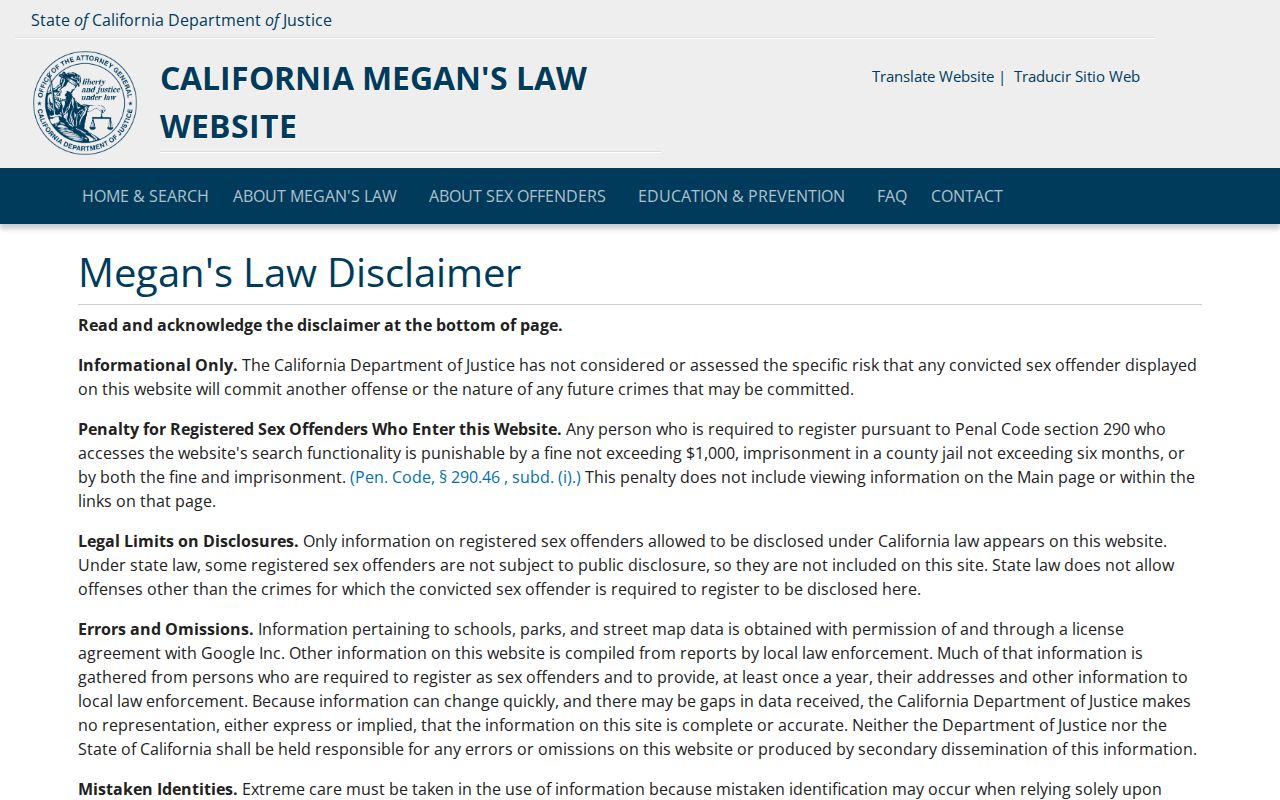
The image points back to the registry's own search context. A Folsom resident lookup is for personal, lawful research, family history, record correction, civic understanding, or reconnecting. Public availability never permits stalking, threats, intimidation, or harm.
Lawful use. California Penal Code §646.9 addresses stalking, and CCP §527.6 provides a harassment and restraining-order process. Verify a disputed record with the custodian and stop when a protected program or sealed record closes the trail.